Your Strength Training Reference Guide (Reps, Sets, and How to Progress)
TL;DR: Everything You Need to Know About Reps, Sets, and Progress
How many reps? How many sets? When do you add weight? These are the questions that come up most often — and the answers are simpler than most people expect. Here is what this post covers:
Why the rep range matters less than most people think — and what actually does
How many sets per week produce real results without overdoing it
A simple rule for knowing exactly when to progress
What to do when you miss a workout
Why you do not have to lift heavy to build strength
👉 Before we dive in → Take the FREE Bone Health Risk Assessment. It takes about three minutes, measures your personal risk factors, and tells you exactly where to focus. Your results are completely private.
The Short Version
If you want the numbers first:
✔ 6–30 reps per set (research supports this full range when training close to fatigue)
✔ Get close to fatigue — your last 2–3 reps should feel genuinely hard
✔ 4–8 sets per muscle group per week to start — build from there
✔ Train each muscle group 2x per week for consistent progress and adequate recovery
✔ Progress gradually — small increases in weight, reps, or sets over time
That's the foundation. Everything below is the "why" behind it.
How Many Reps?
The short answer: anywhere from 6 to 30 — as long as you're working close to your limit.
For a long time, the belief was that you had to lift heavy (low reps) to build strength and muscle. The research has shifted on this. Studies now show that a set of 25 bodyweight reps taken close to fatigue produces similar muscle and strength gains as a set of 8 reps with a heavier load. What matters most isn't the number — it's the effort level at the end of the set.
What this means practically:
You don't need heavy weights to make progress
Bodyweight and resistance band training absolutely counts
Higher rep sets are not "easier" if you're actually working hard
A good rule of thumb: if you could keep going for another 5+ reps and feel totally fine, you haven't done enough. The last 2–3 reps of every set should feel hard — controlled, but hard.
How Many Sets?
Research supports 4–8 sets per muscle group per week as a solid starting range for most people. More experienced lifters may benefit from higher volume, but more is not always better — especially when returning to training or managing a full life alongside your workouts.
A simple way to think about it: if you are training a muscle group twice a week, that might look like 2–3 sets per exercise across 2 sessions — which puts you right in that 4–6 set range for the week without doing anything complicated.
You do not need to do six exercises per session. Two or three well-chosen movements, done consistently and close to fatigue, will get you further than an exhausting rotation you cannot sustain.
How Do I Know When to Progress?
This is the part most people overthink. Here is a simple rule: when an exercise feels manageable throughout — it is time to progress.
Signs you are ready:
You finish your set feeling like you had 5 or more reps left
You have used the same weight for 2–3 weeks without it feeling any harder
Your form feels completely solid and controlled throughout
How to progress:
Add 1–2 lbs for upper body exercises
Add 2–5 lbs for lower body exercises
Add 1–2 reps per set before jumping to a heavier weight
Add one additional set before increasing load
You do not have to do all of these at once. Small, consistent increases over weeks and months add up to significant strength gains over time. This is progressive overload — and it is the single most important principle in strength training.
How Often Should I Train?
2–3 sessions per week per muscle group is the research-supported sweet spot for most people.
More is not always better. Muscles do not grow during training — they grow during recovery. If you are training the same muscle group every day without adequate rest, you are limiting your own progress.
A simple structure that works well:
Full body training 2–3x per week with rest days in between
Or upper/lower splits that allow each muscle group to recover before the next session
Rest days are not wasted days. They are where the adaptation happens.
What If I Miss a Workout?
You pick back up where you left off.
Missing one session does not undo your progress. Missing a week does not either. Consistency over months and years is what builds lasting strength — not perfection week to week.
If you miss a session, do not try to make it up by doubling the next one. Just continue with your regular program. If you have had a longer break of two or more weeks, reduce your weights slightly for the first session back and rebuild from there. Your strength returns faster than it took to build — this is well-documented in the research.
The most important thing is getting back to it.
Do I Have to Lift Heavy?
No — and this is one of the most freeing things the research has given us.
Studies consistently show that lighter loads, including bodyweight, produce similar strength and muscle gains to heavier loads when sets are taken close to fatigue. The weight is just a tool for creating effort. If a resistance band or a pair of light dumbbells is what you have — use them well, work hard, and progress when you can.
What does not work: going through the motions with a weight that feels easy the entire time. The stimulus comes from the effort at the end of the set, not the number on the dumbbell.
FAQs
1. What does close to fatigue actually mean?
It means you could complete maybe 2–3 more reps before your form would break down or you would have to stop. You are not grinding to failure, but you are not leaving 10 reps in the tank either. That last stretch of a set — where it gets genuinely hard — is where most of the training stimulus comes from.
2. Is it ok to do the same exercises every session?
Yes, especially when you are building a consistent habit. Repeating the same movements allows you to track progress clearly and build skill in those patterns. Once the same routine feels very manageable, that is a signal to add variety or increase the challenge — but consistency with a few good exercises beats constantly rotating through new ones.
3. How long before I start seeing results?
Strength improvements can happen within 2–4 weeks, largely through neurological adaptations — your brain gets better at recruiting the muscles you are training. Visible changes in muscle tone typically take longer, around 6–8 weeks of consistent training. Bone density changes take months to show up on a DEXA scan, but the stimulus for remodeling is happening from your very first session.
4. What if an exercise causes pain?
Stop and do not push through it. Pain during training is a signal worth listening to — it is different from the muscle burn or fatigue of a hard set. Modify the range of motion, reduce the load, or swap to a different movement that works the same muscle group. If pain persists, consult a physical therapist or your healthcare provider before continuing.
5. Can I build strength with just bodyweight and resistance bands?
Yes — the research is clear on this. What matters is progressive overload and proximity to fatigue, not the type of equipment. Bodyweight squats, resistance band rows, and similar movements can absolutely build real strength when performed with adequate effort and progressed over time.
The Practical Summary
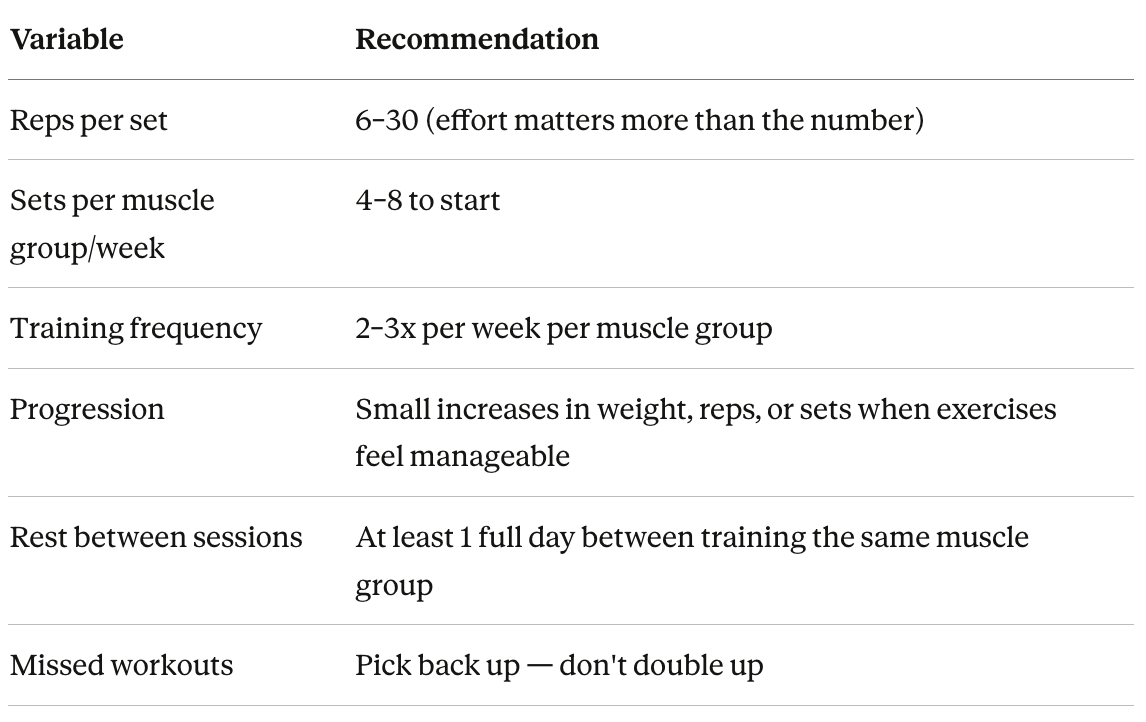
Save this!
Your quick reference guide.
You do not need a complicated program to build real strength. You need a simple one, done consistently over time, with enough effort at the end of each set to actually challenge your muscles.
Pick 2–3 exercises for the muscle groups you want to train. Do them consistently, twice a week. Work close to fatigue. Progress when you are ready. That is the whole system.
Ready to Get Started?
👉 The Bone Health Co. membership gives you everything in one place — a personalized assessment, weekly workouts, balance training, and a PT in your corner every week.
👉 Prefer to start with a standalone program? Train for a Stronger You is a 4-week home-based resistance training program built specifically for bone health — under 30 minutes, no gym required.
This post is for informational purposes only and does not constitute medical advice. Always consult your healthcare provider regarding your bone health.